


Indian quantum physicist, known for the Raman effect: (Why is the sky blue?) Winner of the 1930 Nobel Prize for Physics. Fellow of the Royal Society.
Distinguish from his nephew Subrahmanyan Chandrasekhar, also a distinguished physicist, who discovered the Chandrasekhar limit on the minimum stellar masses which may form black holes.

Indian physicist (1888–1970)
| Born | 7 November 1888 |
| Died | 21 November 1970 |


32 works Add another?
 Most Editions
Most Editions
First Published
Most Recent
Top Rated
Reading Log
Trending
Random
-
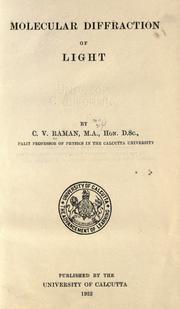
Preview Book
×Close -

-
-

-
-
-
-
-
-
-
-

-


Indian physicist (1888–1970)
| Born | 7 November 1888 |
| Died | 21 November 1970 |
Subjects
Light, Physics, Scattering, Optics, Optics; C. V. Raman, Sound, Bowed stringed instruments, Color, Raman effect, Acoustics, Biography, Couleur, Crystals, Diamonds, Diffraction, Fisica Geral, Flowers, Juvenile literature, Optical mineralogy, Optique, Otica, Holografia, Laser E Cor, Physicists, Pictorial works, Popular Works, ScienceID Numbers
- OLID: OL875534A
- ISNI: 0000000108724554
- Library of Congress Names: n50054438
- SBN/ICCU (National Library Service of Italy): UBOV448758
- VIAF: 14901832
- Wikidata: Q60429
- Inventaire.io: wd:Q60429
Links outside Open Library
No links yet. Add one?
Alternative names
- Raman, Sir Chandrasekhara Venkata
- Sir Chandrasekhara Venkata Raman
- Chandrasekhara Venkata Raman
- Chandrasekhara Venkataraman
- C. V. Raman
- Raman, Chandrasekhara Venkata Sir